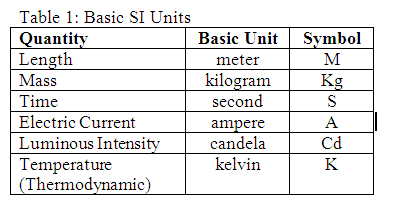
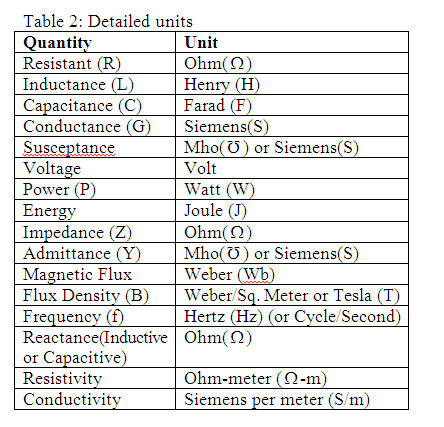
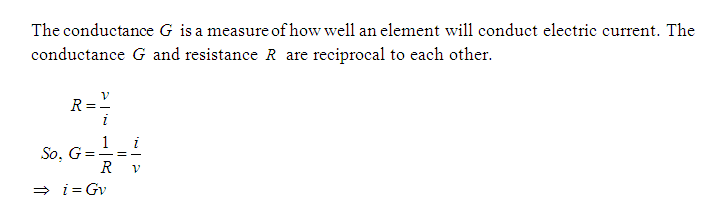
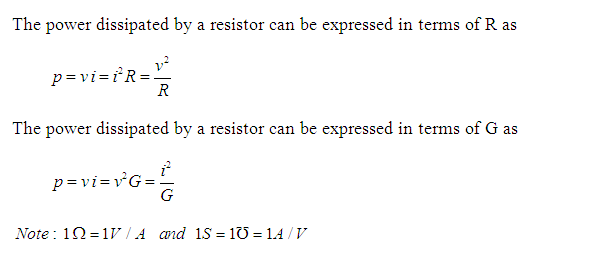
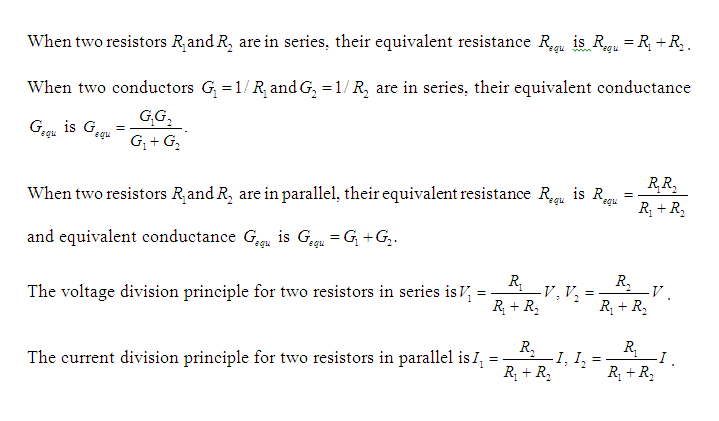
Electric current is the time rate of change of charge, measured in amperes (A).
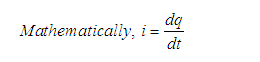
So, 1 ampere=1 coulomb/second
Voltage is the energy required to move a unit charge through an element, measured in volts (V).
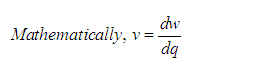
So, 1 volt=1 joule/coulomb=1newton-meter/coulomb.
Power is the time rate of expending or absorbing energy, measured in watts (W).

Note: The law of conservation of energy must be obeyed in any electric circuit. Hence, the algebraic sum of power in a circuit, at any instant of time must be zero.
Circuit Elements: Circuit elements are of two types in electric circuits namely (a) active elements and (b) passive elements. An active element is capable of generating energy while a passive element is not. Typical examples of active elements are generators, batteries, operational amplifiers etc. Examples of passive elements are resistors, inductors and capacitors. Passive elements do not have any intrinsic property of boosting an electric signal. The most important active elements are current or voltage sources which normally deliver power to the circuit connected to them.
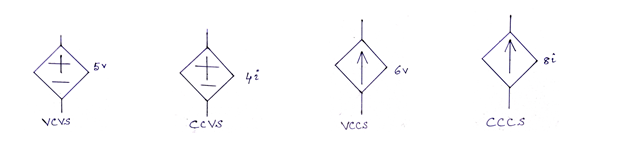
Now sources are of two types: Independent Sources and Dependent Sources. An Independent Source (ideal) is an active element that provides a specified voltage or current which is completely independent of other circuit elements. Examples of independent sources are 10 V, 5 A etc. A dependent source (ideal) is also an active element in which the source quantity is controlled by another voltage or current. Four possible types of dependent sources are
- Voltage Controlled Voltage Source (VCVS), e.g. 5v V.
- Current Controlled Voltage Source (CCVS), e.g. 4i V.
- Voltage Controlled Current Source (VCCS), e.g. 6v A.
- Current Controlled Current Source (CCCS), e.g. 8i A.